Know About Pluto
Pluto is a dwarf planet in the Kuiper belt, a ring of bodies beyond Neptune. It was the first Kuiper belt object to be discovered.
Pluto was discovered by Clyde Tombaugh in 1930 and was originally considered to be the ninth planet from the Sun. After 1992, its status as a planet was questioned following the discovery of several objects of similar size in the Kuiper belt. In 2005,Eris, a dwarf planet in the scattered disc which is 27% more massive than Pluto, was discovered. This led the International Astronomical Union to define the term "planet" formally in 2006, during their 26th General Assembly. That definition excluded Pluto and reclassified it as a dwarf planet. (taken from wiki) (read about Pluto on wikipedia)
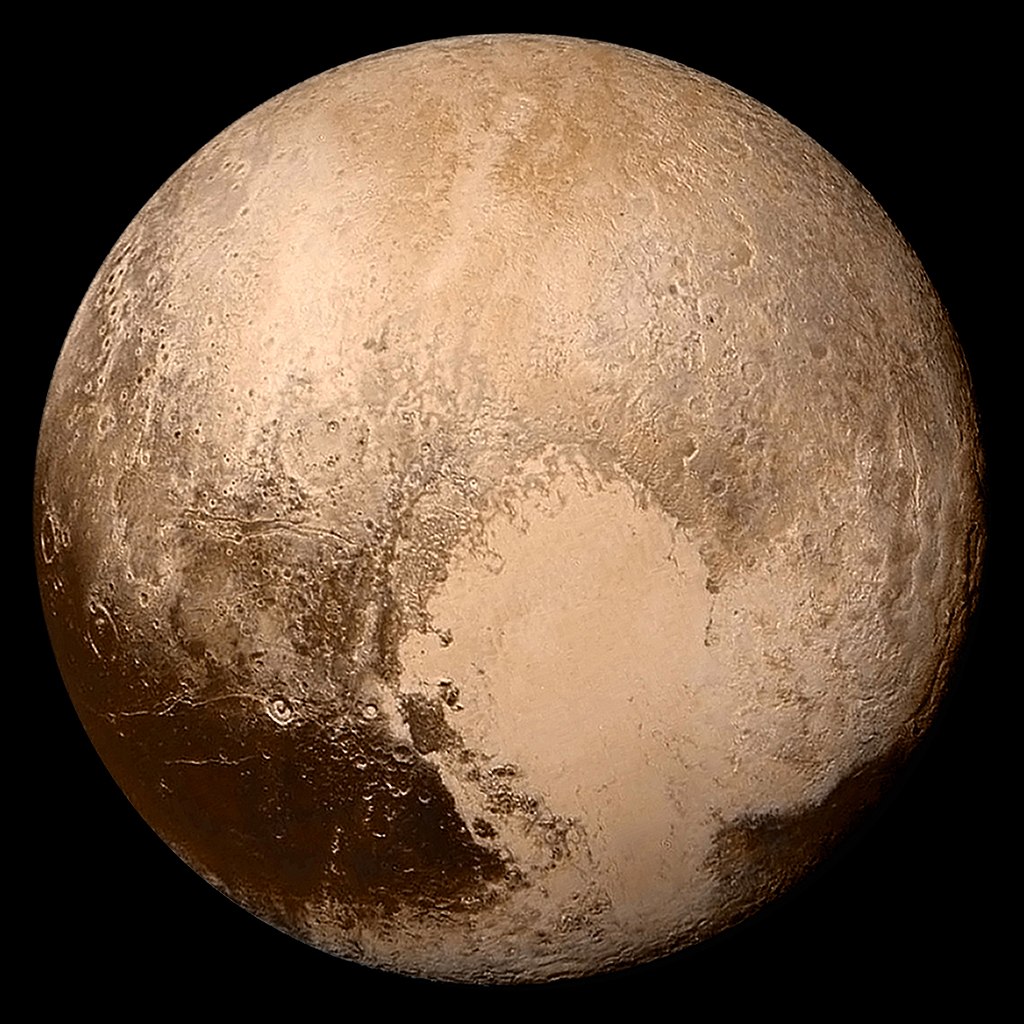
Pluto—which is smaller than Earth’s Moon—has a heart-shaped glacier that’s the size of Texas and Oklahoma. This fascinating world has blue skies, spinning moons, mountains as high as the Rockies, and it snows—but the snow is red. These are details we didn't know before NASA's New Horizons spacecraft flew past in July 2015.

The reddish enhanced color image shown as the left inset reveals a mountain range located in southeast Cthulhu that’s 420 kilometers long.
The range is situated among craters, with narrow valleys separating its peaks. The upper slopes of the highest peaks are coated with a bright material that contrasts sharply with the dark red color of the surrounding plains.
Compositional data from the Ralph/Multispectral Visible Imaging Camera on NASA’s New Horizons spacecraft, shown in the right inset, indicates that the location of the bright ice on the mountain peaks correlates almost exactly with the distribution of methane ice, shown in false color as purple.
The image was obtained by New Horizons at a range of approximately 33,900 kilometers from Pluto, about 45 minutes before the spacecraft’s closest approach to Pluto on July 14, 2015.
Pluto is a complex and mysterious world of mountains, valleys, plains and craters. Discovered in 1930, Pluto was long considered our solar system's ninth planet. But after the discovery of similar intriguing worlds deeper in the distant Kuiper Belt, icy Pluto was reclassified as a dwarf planet.


Things to Know About Pluto
-Pluto is about 1,400 miles (2,380 km) wide. That's 2/3 the width of Earth's moon.
-Pluto orbits the Sun about 5.8 billion km away on average, about 40 times as far as Earth, in a region called the Kuiper Belt.
-A year on Pluto is 248 Earth years. A day on Pluto lasts 153 hours, or about 6 Earth days.
-Pluto has a thin atmosphere of nitrogen, methane and carbon monoxide. The atmosphere has a blue tint and distinct layers of haze.
-Pluto has 5 moons. The largest, Charon, is so big that Pluto and Charon orbit each other like a double planet.
-Pluto’s surface is far too cold, -378 to -396 degrees F (-228 to -238 C), to sustain life as we know it.
-Pluto have Majestic Mountains and Frozen Plains

How Pluto Got its Name?
Pluto is the only world (so far) named by an 11-year-old girl. In 1930, Venetia Burney of Oxford, England, suggested to her grandfather that the new discovery be named for the Roman god of the underworld. He forwarded the name to the Lowell Observatory and it was selected.
Pluto's Orbit
Pluto's orbital period is presently about 248 years. Its orbital characteristics are substantially different from those of the planets, which follow nearly circular orbits around the Sun close to a flat reference plane called the ecliptic. In contrast, Pluto's orbit is moderately inclined relative to the ecliptic (over 17°) and moderately eccentric (elliptical). This eccentricity means a small region of Pluto's orbit lies closer to the Sun than Neptune's.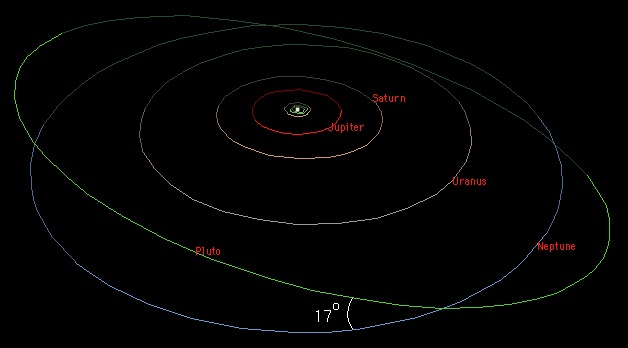


Niciun comentariu:
Trimiteți un comentariu