The James Webb Space Telescope is a space telescope developed in coordination among NASA, the European Space Agency, and the Canadian Space Agency. Will be located near the Earth–Sun. The telescope will offer unprecedented resolution and sensitivity from the long-wavelength (orange to red) visible light through the mid-infrared range.
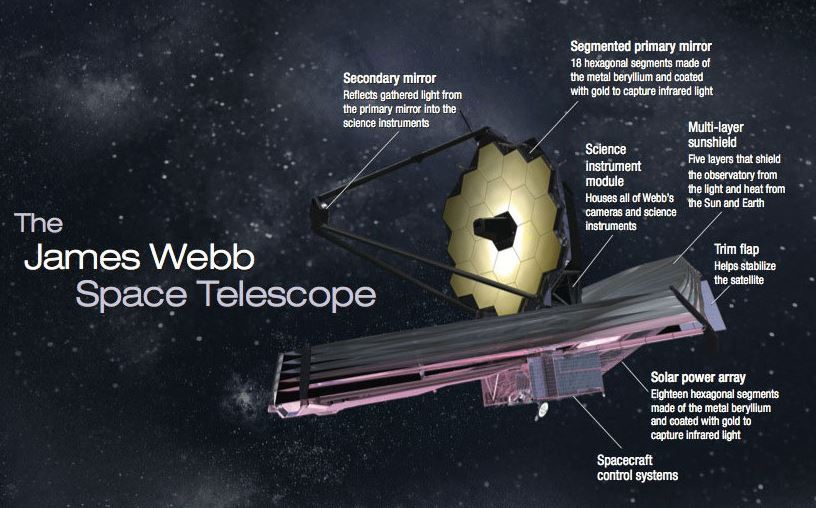
JWST is the formal successor to the Hubble Space Telescope, and since its primary emphasis is on infrared observation, it is also a successor to the Spitzer Space Telescope. JWST will far surpass both those telescopes, being able to see many more and much older stars and galaxies. Observing in the infrared is a key technique for achieving this, because it better penetrates obscuring dust and gas, allows observation of dim cooler objects, and because of cosmological redshift. Since water vapor and carbon dioxide in the Earth's atmosphere strongly absorbs most infrared, ground-based infrared astronomy is limited to narrow wavelength ranges where the atmosphere absorbs less strongly. Additionally, the atmosphere itself radiates in the infrared, often overwhelming light from the object being observed. This makes space the ideal position for infrared observation.
There are some images


Watch a video about it
CLICK HERE TO WATCH THE VIDEO (open in youtube)
MORE INFOS
-Proposed Launch Date -
Webb will be launched in Spring 2019
-Mass of primary mirror - 705 kg
-Number of primary mirror segments - 18
- Orbit - 1.5 million km from Earth
- Focal length - 131.4 meters

Niciun comentariu:
Trimiteți un comentariu